Wednesday, July 24, 2013

masks and expression


In my work as an MFT Intern, I get to really delve into one of my passions - using art in therapy.

A few weeks ago I went into a classroom of adults with intellectual disabilities to do an art workshop. We created masks. I was pleased with the outcome for several reasons -

1. It was an adult form of expression. Too frequently, these students are given really child-like craft tasks to do - pages from coloring books, stringing pony beads, things like that. Now - I love me some coloring books, but I take issue when they are given as the only option, and because of a perceived lack of ability or skill. They met my level of expectation, which was high.


2. It was an open-ended art form. Creating a mask from mixed-media is a very different thing than "follow this pattern and color inside these shapes." Doing something this open-ended requires imagination, perseverance, creativity, problem-solving, and a certain amount of courage.


3. They filled the time and the space. We had a certain amount of time to fill and 30 students in the class. A lot of times in that situation, a handful of people will finish really fast, and then be bored, while the rest take longer. Going beyond the time it takes - a lot of people will glue two things on a piece of paper and then decide they are done. I really wanted to push the students to do more - to use layers, depth, and a lot more materials. They did. I made this happen in a few ways - a) I rotated supplies, so every 10 minutes they'd get something new. b)I showed examples of masks in museums for some inspiration. c)I demonstrated how one material could be used in a lot of different ways. d)I used art vocabulary - such as dynamic, energetic, depth, layers, complexity, repetition - and they kept going with it.

So I wanted to share some photos - for obvious reasons, photos of the actual students have been left out. But their work, I think, speaks for itself.


Sunday, July 7, 2013

My Selfish Blanket

The events of my life could be described by what project I am working on. When something big happens, my first thought is, "what yarn goes with this?" When we go on a trip, when a friend gets pregnant, with every holiday, and with every bit of grief or sadness. 


When my daughter died last October, a week before her due date, one of the most strange things about my sadness was that my hands weren't busy. I had been making baby clothes, soakers and stuffed animals - and then when I got out of the hospital I put all that away and did not know what to do. I didn't want to start a new project, which would forever remind me of the excruciating pain I was in. I ended up working on a cross-stitch project that I had already been working on for about 2 years - a photo of my husband and I dancing at our wedding. It was time-consuming (a blessing when you are grieving), did not take much thought (also helpful), and the photo of my husband and I holding each other helped me remember to be grateful, even then.
It has been almost 9 months since then, and I have worked on a lot of other projects since. But despite the growing number of friends I have who are pregnant or have babies, I have not been able to bring myself to work on any baby-related item. Instead, I decided to start something entirely for me. I've been calling it My Selfish Blanket, and it has helped me remember that I need to take care of myself, too.

It's a knitted blanket, made with sock yarn, on size 3 double pointed needles. So far I've been averaging about a square per week. I currently have 13 squares done, and 1 on the needles. I figure I'll need about 80 squares to have a good-sized blanket. 

The way the rest of the knitting world knows this blanket is by the name Barn Raising Quilt - the idea is that a lot of people each knit one square, and contribute. There is something resentful and rebellious in me that rises up and thinks I Can Do This On My Own - that I don't want anyone else to touch this, all those people who get their babies and their families and don't know what it's like.

 That feeling ebbs and flows - and another takes its place. There's something about the insanity of this project - the fact that I am making a queen-sized blanket on sock yarn and size 3 needles, the fact that it will take me at least a year to complete, the vastness of this project that reminds me of the work that goes into living a grieving life. That there is this huge, seemingly insurmountable chore in front of you, and all you can do is take another breath, knit another stitch, keep going because that's where the work is, that's what you have to do.


Tuesday, July 2, 2013

post-conference and some new crafty items

This weekend I went to the CHN conference in Torrance. I had a really, really good time - I did 1 talk, and 4 workshops, and was also able to sit and sell my items in the vendor hall all weekend! I love conferences, and will do more posts with photos from some of the different workshops, with descriptions. 

But for now - one of the things I love about conferences is the inspiration I get for new products. So here's the first photos of some new things...
itty bitty crocheted bows, these are for your hair, but I'll be doing rings and earrings too

large heart rings and earrings are a big seller of mine, but these have the americana twist :)

these are earring holders made with lace, burlap, and embroidery hoops. They are light, lovely,and a great display for your jewelry, and mine....

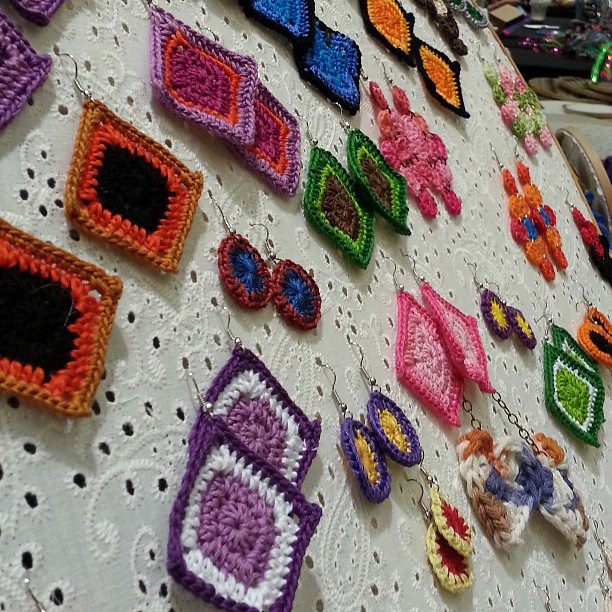
In the vendor hall, some of my earrings on display!
No promises as to when these will be on my showyourcolorz etsy site, but I am having fun making them!!!

4 Art Projects That Will Make You Slow Down and Take Notice


As a Marriage and Family Therapist Intern, one of the most frequent complaints I hear from my clients is that they feel stressed out and hectic. Parents come to my office after dropping their kids off at a class, between practices, or from play groups. They are busy making their homes enriched, wonderful places for their children to be. If their children don’t need them, their significant other does. I have teenagers come to my office feeling like they are under pressure, too – with schoolwork, conflict in their social groups, or the feeling of being pulled in too many directions. Even the little kids I see these days seem more frantic, being shuttled from activity to activity.

I also have a BA in Recreation. I am all for hobbies, classes, and pursuing your interests. But I also see a pattern among my clients where they fill all the gaps in their days, without leaving time to slow down and see what happens naturally. When you don’t leave some gaps of time, you miss out on some of the sweeter things in life. Small miracles start escaping you. You might stop noticing the tomato plant going from blossom to fruit in the backyard. You might move so fast you miss the lizard scuttling out of your way. The tiny and beautiful details of the world around you gets lost in the rush to get out the door and into the car, to move on to the next thing, the next group, activity, or event.

Even in the midst of a busy life, you can schedule in some time to slow down and learn how to hone your awareness again. Art can be really helpful in this process. Here are several art projects that you can do that will help you slow down and take notice.

1.       Cut a small rectangle out of the center of a piece of cardstock. Hold that piece of paper up about 8-10” from your face. Using colored pencils, draw only what you can see through that cut-out rectangle.  Use this frame to help narrow your focus, eliminate distractions, and take the time to notice all that goes on in that small, compact space.

2.       Go to a favorite place in nature, such as a park, field, or garden. Draw the outline of your hand on a piece of paper. Then place your hand on the ground. Lifting it up, look at what fit underneath that space, and draw it on your paper in as much detail as possible. Focus on how amazing it is that so much detail can fit in the palm of your hand.

3.       Close your eyes and think about your favorite place to visit. Try to imagine you are there, using all of your senses. Use markers and paper to try to recreate it on paper, trying to get in as many details as you can. If someone you know has been there also, enlist their help in coming up with an even richer description, or see if they can recognize the location based on your drawing.

4.       With a partner: choose an object, such as a favorite mug, stuffed animal, or book. Do not tell your partner what you have chosen. Give them crayons and paper, and carefully describe the details of the object while they draw only what you tell them. Make sure you cannot see their paper, and they cannot see your object. When you think you are done describing it, you get to look at what they’ve created and see if your powers of observation and description are finely honed or could use more practice.

Thursday, June 13, 2013

5 art projects to do when you’re anxious

5 art projects to do when you’re anxious

Anxiety can rear its ugly head at the worst moments.  Sometimes it is predictable – you have a presentation, or event that you are nervous about and your nerves grow, and grow. Sometimes anxiety manifests itself as a panic attack – which can be a sudden moment of heart-racing, tight-chested panic where you feel like you can’t breathe. The terrible thing about experiencing panic or anxiety, is that once you know what it feels like, it seems to come more frequently. When we experience anxiety, our bodies do a few things to protect us. We either go into flight, fight, or freeze mode. Our heart rates rise, we get tunnel-vision, and we are super-focused on the thing that is causing us anxiety. In the past, this was a survival technique. Imagine your ancestor hunting in the jungle – they are focused, breathing shallowly, and intent on every little noise. They would have had a heightened response to anything that might startle them – in order to hunt, and in case they were being hunted by their own predators. So these physical responses were helpful, then.
But when is the last time you've been hunted by an animal in the jungle? When you are preparing for a meeting, or class presentation, the responses your body has left over from years past are not necessarily the most helpful ones. Instead of shallow breathing, you want to take deep breaths, in order to get oxygen flowing to all of your body, get outside of that tunnel vision, and be able to think creatively and on your feet.

There are some people who seem like they are calm and at peace all the time. They face situations that would cause the rest of us anxiety and stress with open arms and never seem like it is a challenge. Do you want to be more like that? You can actually practice anxiety-reducing techniques, even when you are not in a stressful situation that will help you face those situations more calmly. You can build calm habits.

You can use art to do this. Art is a great way to express the inner-anxiety, and work towards calm. It has the benefit of having a tactile experience that can connect with the primal part of you that might have gone into flight/fight/freeze mode. You can also create visual reminders for yourself to keep around your home or office to get you back into a calmer state. Here are 5 different art projects you can do to practice breathing deep, having a sense of well-being and reducing your stress or anxiety.

  •  Imagine that you are staring deep into a body of water. Perhaps it is the ocean, with its predictable and calming repetition of waves crashing over, and over. Maybe it is a river, splashing over rocks and branches. Maybe it is a favorite lake. In any case, think about the water, whether it keeps moving on, determined and never-ending, or a still and flat surface that you can stare at forever. Use water-color paints to capture that feeling. Use a lot of water, and as you paint, take away the lessons from the ocean, river, or lake that are helpful to you.
  •  Imagine a place outdoor where you feel safe. Are there trees? Flowers? Is it in the mountains, the desert, or forest? Is there water nearby? Close your eyes and picture it, imagine what the air would feel like on your skin. Imagine the smells. Picture the light as it shines down on the plants and landscape around you. Use pastels to draw this place. Pastels are pretty messy, and smear very easily, which is why they are great for this. You are not trying to draw a perfect representation of what this place looks like, but get the calm and safe feeling across.
  • Charcoal is an incredibly messy medium. It’s a great tactile experience for getting your stress out! For 30 seconds, use charcoal on paper and write words associated with your panic, pressing hard with the charcoal. After you are done, take a few minutes and think calming, helpful thoughts as you use your fingers to smear the words on the page. Take deep breaths while you do this, and watch as the harsh lines start to soften.
  • People frequently describe anxiety as a monster that lives inside of them. Use clay (or play doh) to create your anxiety monster. Take a good long look at this monster, and think about what you need to defend yourself from it. Make that out of clay, and use it to defeat the anxiety. Bonus: you can smash clay, throw it, roll it into a ball and flatten it. Try taking action against your clay anxiety monster!
  • If you’re facing a situation, event, or project that is contributing to your anxiety, it can help to create a visual “to do” collage. Use magazines, glue and paper to create a collage of things that will help you accomplish this goal. Forgo the scissors – rip the pages from the magazines. You’ll find that is a stress-buster in itself!


Did you try any of these? Which ones helped you overcome your anxiety? Do you use any other art techniques to help?

Sunday, June 9, 2013

10 Lists to Write When You're Feeling Stuck

10 Lists to Write When You're Feeling Stuck

Everyone has moments of feeling stuck. Stymied. Directionless.  It is not a great feeling –it can spiral into apathy, depression, anxiety, and despair. Guilt and shame are frequently associated with it, and it’s hard to get rid of those voices from your past that are telling you that you are doing something wrong.  You might be watching other people accomplishing things and wondering where your motivation went. Maybe you are wondering if you ever had any to start with. Maybe this is a feeling that is far-too familiar, or maybe it’s temporary. Maybe there are other times you might be the most driven person, with goals and checklists. Maybe you’re not, and you've been feeling a little apathetic for a while now.  It could be because you have a few really big projects looming, and you are having difficulty with where to start. Maybe you’re feeling guilty that you aren't doing more, so you don’t do anything at all. Maybe you’re a perfectionist, so if you can’t do something perfectly you don’t try at all. Maybe you are a caretaker, putting other’s needs in front of your own for so long that you are having trouble getting back to you.

 When you’re in that sort of funk, it can be hard to see a way out. I am a big believer of writing – I think putting things down on paper makes you accountable, helps define and articulate your thoughts, and frees up your brain from excessive worry and spiraling. When you are feeling stuck, however, the thought of putting pen to paper, or filling up that blank screen can be intimidating or distasteful. That’s why I love lists. Lists are simple. Lists are easy. Lists can be one-word answers, or you can elaborate. They’re like a warm-up before you exercise, they get the mind all limber and sweaty. So if you are feeling stuck, here is a list of lists to write. Use them how you need to use them – one at a time over the course of weeks, or a marathon-listing right now.

·         10 things I want to do before I die
·         10 beautiful places I have already been
·         My 10 favorite pinterest projects
·         10 of the most energetic songs I know
·         10 things that need to happen to get to one of my “things I want to do before I die”
·         10 most inspiring people
·         10 reasons I Just Don’t Wanna
·         10 times I have been proud of myself
·         10 things that other people are asking of me
·         10 things that could happen if I went outside today


Go forth and write lists! Let this list inspire you to make your own set of lists! Which did you find particularly helpful? Any new ideas you’d like to share?

Friday, May 31, 2013

so much to do!

I have been asked if not having a *teacher* would be a detriment when I got out into the work-force, and make working with a boss difficult. Most people who asked me this seemed to think that not having a teacher to practice taking direction from would mean I wouldn't be able to work for someone else. I always laughed this off - but I've been thinking about it more and more the last few weeks and thought it deserved a little bloggy attention.

Right now, I am working very hard to get my own private practice off the ground. I am a Marriage and Family Therapist intern, and I have two locations. One is in Los Alamitos, and one is in Arcadia. I just started at the one in Arcadia. I have two supervisors - in the therapy world, a supervisor is not a boss, but as someone who is willing to put their license on the line for you, meet with you weekly, and sign your paperwork. I also have two etsy sites, where I sell my jewelry. I have a job-with-a-boss as well, but at the moment I work from home.

It only recently occurred to me that all my life I have been striving to get to a place where I am my own boss. And I've always liked the bosses I've had. I am still friends with most of them, in fact. There was only one experience that I had a boss who I thought was sabotaging me. I was not the only person to have a really terrible experience with her, and I was lucky that several months later, she ended up leaving the company. So it's not that I can't get along with someone "in charge" of me - but it's just not how I want to work, long-term.

I like the idea of working for myself and have never been afraid of the fact that when you are your own boss, you don't get 8-5 hours and then leave the work at work. I always liked to throw myself into something, and would want the thing that made me money to be included in that. I want a flexible schedule, and to be able to use all the different tools I like to work with - get to design flyers, use social media, meet with people, and do art. Working for myself means getting to do more of what I'm good at, while finding resources to help with my weaknesses. I like this idea. I like being accountable to me, and frankly, I like being in charge.

Today, however, is a day where I am trying to take deep breaths and re-focus, because I am starting to get overwhelmed. I am realizing that getting my practice up and running also means there are no limits to what I can do - so there are NO LIMITS to what I am trying to do. So it's a lot. This morning, for example, I had all my paperwork scattered over the coffee table, my phone was ringing, and I have at least 15 tabs open on the computer. If I don't reach out and market myself, I won't get clients, and I won't succeed at having a private practice. I won't get a paycheck. It won't work. I suddenly got the other side of not having a boss. It's. Up. To. Me.

I love all the side-projects that come along with this business - I love making my website, making business cards, speaking at conferences - but it takes up a lot of time, and at the moment I don't really know which things are the most effective, so I am trying them all. I stay up late at night putting together blogs and email newsletters... it sort of reminds me of when I'd stay up all night collaging my journal or making a zine. Except I'm trying to make a living at this.

I am sure there is a connection between unschooling and my desires for my career and profession. I have a lot of drive and passion - fostered by my parents and the decision to unschool. I know how I work the best, again thanks to unschooling. I have high expectations for myself and a really supportive and responsive community to work within - thanks, unschoolers. I do not think that this connection is true for all unschoolers - because I know plenty who work for other companies very happily. I just know that I want a life full of projects that I get to decide how much energy I invest. Right now I am investing a lot of energy in a lot of things. Some of the things that give me the most energy have nothing to do with making money -- like the 30 Day Challenge Group I run on facebook, working with the board of HSC on their conference and newsletter, this blog!

So that's all for this post. No huge revelation or anything - just another glimpse into who I am, and some connections to unschooling.

Do you work for yourself? What are some things you've learned along the way? If you work for someone else, any stories to share on the topic?